South Jordan City Parks and Open Space Water Shortage Irrigation Response Plan
South Jordan City
Parks and Open Space Water Shortage Irrigation Response
South Jordan City’s parks irrigation plan explains how the City will manage watering during drought or water shortages while protecting the most important public landscape assets. The main priority is to preserve trees, especially newly planted trees, because they take years to replace.
Athletic fields, event spaces, and other high-use park areas will also be protected as much as possible because they serve the community. Lower-priority grass areas, park strips, and natural open spaces may receive less water and may turn brown or go dormant during shortages.
As drought conditions become more serious, the City will reduce watering schedules, shut off low-priority irrigation zones, limit decorative water features, and shift more resources to deep watering trees by hand or with emergency methods. Residents may see brown grass in parks, but that does not necessarily mean the grass is dead.
The plan follows the City’s phased drought response system and is designed to conserve water while protecting the landscapes that are hardest to replace and most important for public use.
Purpose & Summary
This plan is designed to provide guidance for maintaining critical landscape assets, protecting long-term landscape infrastructure (especially trees and athletic fields), and aligning Parks irrigation practices with the City’s and Jordan Valley Water Conservancy District’s phased water shortage response plans.
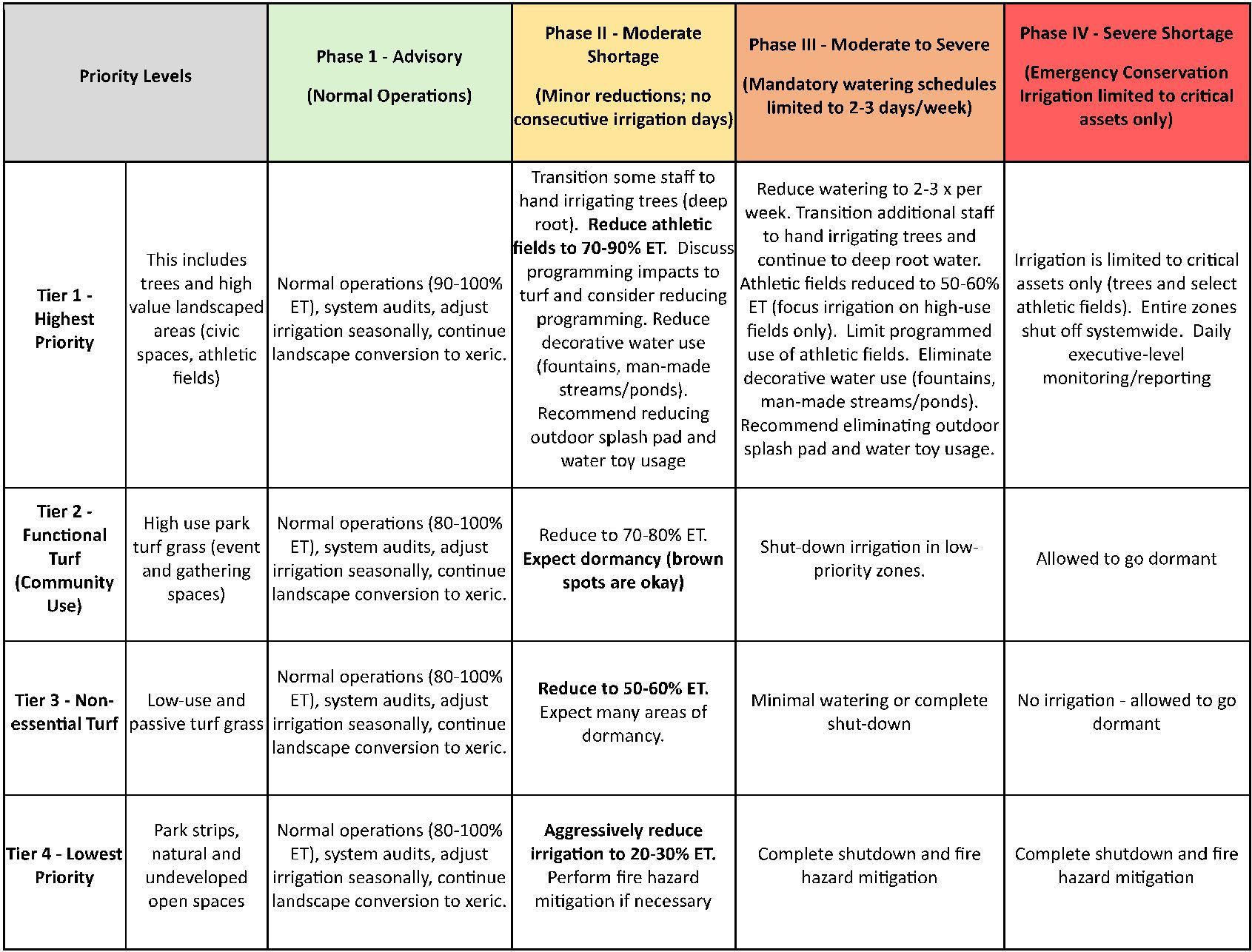
This plan mirrors the City’s Phase I – IV drought framework and applies it operationally to parks, park strips, and other open spaces.
The key principle that guides this plan is to preserve what cannot be quickly replaced (trees), sustain what serves the community (fields and event space), and sacrifice what can recover (turf & natural open spaces).
This plan is divided into the following sections:
- Systemwide Irrigation Priorities (this section identifies the irrigation priorities throughout the City’s parks and open space system)
- Irrigation Strategy by Water Shortage Phase (this section defines the approach to irrigation practices, applied restrictions, and key actions according to priorities for each phase of water shortage)
- Secondary Water Considerations (details considerations for secondary water shortage)
- Operational Tools & Best Practices (identifies tools and best practices to be considered during water shortages)
- Communication Plan (details what to be communicated and to whom)
- Triggers for Escalation (outlines how triggers for each phase are determined)
System-wide Irrigation Priorities (Applies to all phases)
Tier 1 – Highest Priority (Preservation Assets)
Trees (~ 8,500 trees citywide)
Newly planted trees (first 1-5 years)
High-value landscaped areas (civic spaces, athletic fields
Goal: Prevent permanent loss
Method: Deep, infrequent watering
Tier 2 – Functional Turf (Community Use) • High-use park turf (event spaces, gathering areas) Goal: Maintain safe gathering surfaces Method: Reduce frequency, maintain root depth
Tier 3 – Non-Essential Turf • Low-use park turf and open space grass • Passive turf areas Goal: Survival only (not aesthetics) Method: Minimal irrigation to prevent total loss
Tier 4 – Lowest Priority • Park strips • Natural landscaped areas • Undeveloped open space Goal: Water conservation (accept summer dormancy) Method: Aggressive water reductions early
Irrigation Strategy by Water Shortage Phase
Phase 1 – Advisory (Normal operations with conservation emphasis)
Operations
• Normal operations
• Audit irrigation systems (efficiency, leaks, coverage)
• Adjust controllers seasonally (no overwatering)
• Begin public-facing drought messaging in parks where appropriate
Irrigation Approach
• Trees: Water normally, as deep as possible
• Athletic Fields: 80% - 100% ET replacement (the irrigation practice of replenishing water lost from soil evaporation and plant transpiration to maintain optimal soil moisture and crop health)
• Non-essential turf: 80% - 100% ET Replacement
Key Actions
• Increase central control usage
• Convert landscape to xeric and drip conversion where feasible
• Track water use by park/zone
Phase II – Moderate Shortage (Minor reductions; no consecutive watering)
Operations
• Eliminate consecutive-day irrigation cycles where they exist.
• Implement systemwide watering schedules rest days
• Increase monitoring of dry spots and system failures
Irrigation Approach
• Trees: Focus on deep watering, transition to water by hand and water bladders (no reduction)
• Athletic fields: Reduce to ~ 70% - 80% ET
• Non-essential Turf: Reduce to ~ 50% - 60% ET (brown spots are okay)
• Tier 4: Aggressively reduce irrigation and perform fire hazard mitigation where necessary
Restrictions Applied to Parks
• No irrigation between 8 AM and 8 PM • Reduce spray irrigation runtime
• Shut-off irrigation during/after rain events, duration of shut-off determined by each storm severity and location
• Reduce decorative water use (fountains, manmade streams and ponds) • Recommend reducing outdoor splash pad and water toy usage
Key Actions
• Identify “sacrifice zones” (low-priority turf)
• Discuss reducing athletic field usage to maintain turf health
• Increase communication with recreation/sports users
• Shift some staff to hand-watering trees if needed
• Begin drying down park strips
Phase III – Moderate to Severe (Mandatory reductions; strict scheduling)
Operations
• Mandatory watering schedules (2-3 days/week equivalent)
• Shut-down irrigation in low-priority zones
• Daily monitoring of system performance
Irrigation Approach
• Trees: continue to focus on deep watering, water by hand and water bladders (critical asset protection)
• Athletic fields: Reduce to ~50% - 60% ET, focus on high-use fields only. Limit programmed use
• Non-essential turf: Minimal watering or complete shut-down
Restrictions Applied
• No hard surface washing
• Eliminate decorative water use (fountains, manmade streams and ponds)
• Recommend eliminating outdoor splash pads and water toy usage
• Limit irrigation to assigned days and windows
Key Actions
• Convert athletic fields to “survival mode” between events
• Drastically reduce or eliminate programmed sports on athletic fields
• Aggressively reduce irrigation run times
• Shift additional staff to hand-watering trees
Phase IV – Severe Shortage (Emergency conservation; survival only)
Operations
• Irrigation limited to critical assets only
• Entire zones shut off systemwide
• Daily executive-level monitoring/reporting Irrigation Approach
• Trees: Top priority, deep watering by hand
• Sports Fields: Maintain only select priority fields (game-ready only); others go dormant
• Non-Essential Turf: No irrigation (allowed to go dormant)
Restrictions Applied
• 1-2 watering days/week, only where allowed
• No refilling decorative water features (fountains, manmade streams and ponds)
• Eliminate all non-essential irrigation
Key Actions
• Establish “critical athletic field list” (limited playable inventory)
• Deploy emergency watering methods (water tucks, water trailers, more hand watering practices)
• Accept turf loss in low-priority areas
Secondary Water Considerations
• Monitor Utah Lake supply closely during phases II - IV
• Expect faster escalation to severe restrictions
• Prioritize trees and athletic fields only in severe phases
• Prepare for complete shutdown scenarios if canal delivery stops
Operational Tools & Best Practices
System Management
• Central irrigation control system
• Flow sensors & leak detection
• Zone-by-zone runtime reduction
• Cycle/soak runtimes
Field Practices
• Water between 8 PM – 8 AM
• Cycle/soak method to prevent runoff
• Raise mowing heights (reduces stress and encourages deeper roots)
• Aerate to improve water penetration
Communication Plan (critical for success)
Internal
• Weekly drought status updates to PW Leaders & City Admin
• Field staff briefings determined by phase (weekly during phases II – IV)
• Clear priority maps (priority tiers 1-4 zones)
Public
• Park signage: “Drought Mode Irrigation” language
• Messaging explaining “Brown grass ≠ dead grass and trees are the priority
• Coordinate messaging with other City-wide drought phase announcements
Triggers for Escalation (Operational Alignment)
Use the same triggers defined in the South Jordan City Water Shortage Management Plan that is part of the greater 2025 Water Conservation Plan Update to escalate response.
• Reservoir/storage levels below normal
• JVWCD curtailment directives
• Supply dropping to
o ~95% → Phase II
o ~90% → Phase III
o ~70% → Phase IV